
September 2, 2026
Wearing a Colored Diamond on an Ordinary Day
A colored diamond is easier to wear every day than a colorless one of the same size, because color is legible at a distance where brightness is not.
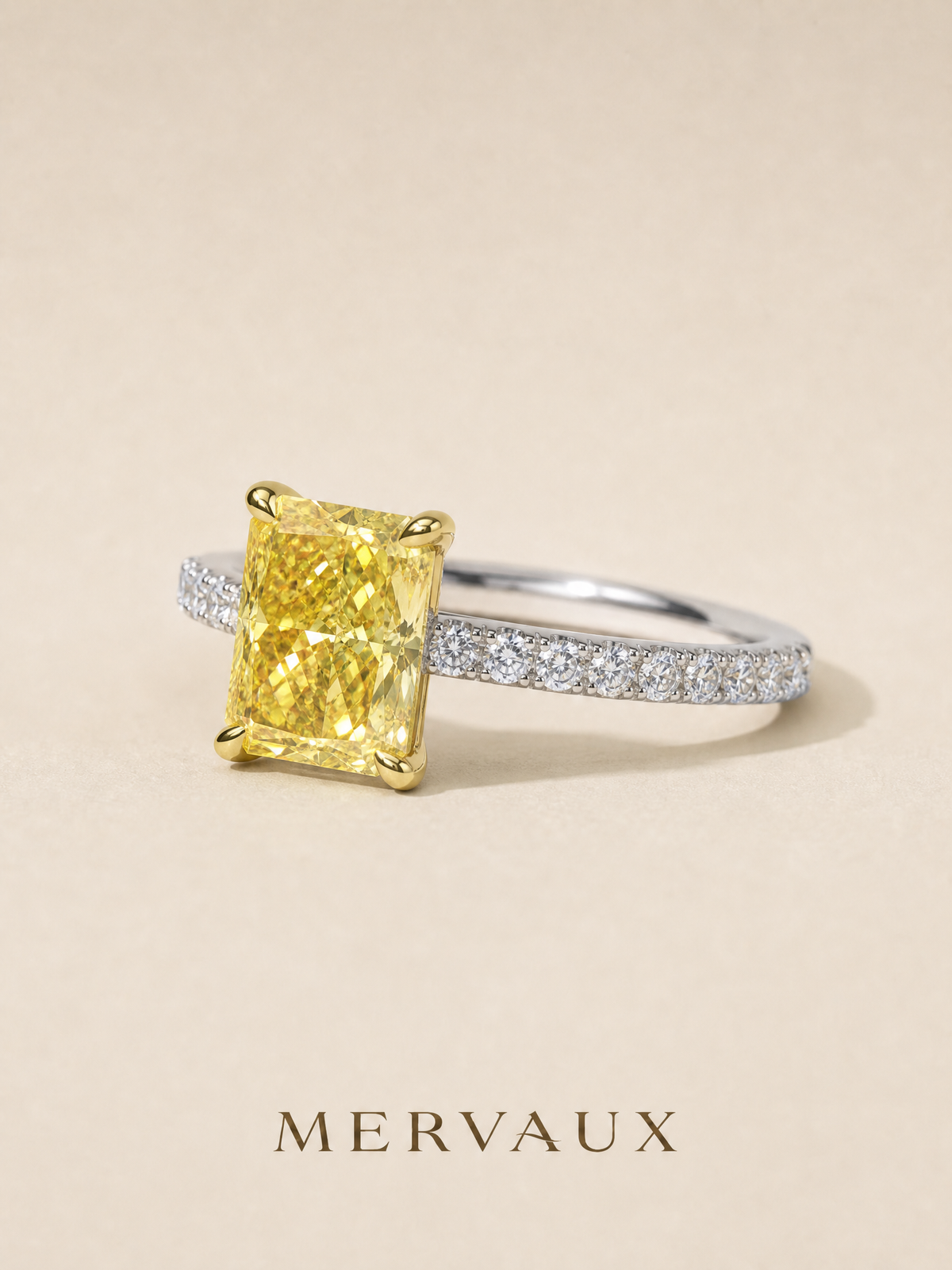
A colored diamond is easier to wear every day than a colorless one of the same size, for a reason that has nothing to do with taste. Color is legible at a distance where brightness is not, so a fancy color stone can be smaller, set lower and still be the thing a room notices. That makes it a practical everyday choice rather than an occasion piece, which is the opposite of how it is usually sold.
Most writing about fancy color treats it as an escalation: the thing you buy after the colorless one, for the anniversary rather than the Tuesday. We think that is backwards, and the argument is mechanical.

A hand wearing a ring set with a yellow radiant cut diamond and a line of small colorless stones along the band.
Color survives bad light. Brightness does not
A round brilliant works by taking a light source and dividing it. It needs a source small enough to cut, which means direct sun or a lamp. Under an overcast sky, an office ceiling or a video call's flat frontal light, there is nothing for it to divide and the stone reads as a small dark point.
Color does not depend on that. A saturated stone returns its hue in diffuse light, in flat light, in the shade, on a screen. It is doing something a brilliant cut cannot do, which is to be visible in the light most of a day actually contains.
This is why a modest colored stone often reads larger than a bigger colorless one at conversational distance. Not because it is larger. Because it is legible for more hours.
What the grade is telling you
The fancy color ladder runs Fancy Light, Fancy, Fancy Intense, Fancy Vivid, and the step people misread is the last one. Vivid is not darker than Intense. It is more saturated, which is a different axis, and a stone can be deeper in tone and lower in saturation at the same time.
The full explanation of how those grades work is worth reading before buying, because it is the only field on the report that is doing the work you are paying for. Everything else on a fancy color report matters less than it does on a colorless stone.
Cut is where the biggest practical difference sits. A round brilliant is cut to return light quickly, which is exactly what dilutes color. Elongated and step-influenced shapes hold light inside the stone longer, so radiant, cushion and oval cuts carry color far better and are what fancy color stones are almost always cut into. That is a decision made for the color, not for the shape, and it is why the shape choice is narrower here than it is with colorless stones.
Which colors work at daily scale
What we hold runs pink, yellow and blue, from Fancy Light through Fancy Vivid, and they behave differently at small sizes.
Yellow is the most robust. It holds saturation at small carat weights better than pink does, it reads warm against every skin tone, and it is unmistakable in flat light. A 1.5 ct Fancy Vivid Yellow radiant at that grade is not a subtle object, but a Fancy Intense at the same weight sits comfortably inside an everyday piece.
Pink needs more weight to read. Pink saturation falls off faster as a stone gets smaller, which is why a small pink stone often reads as a warm colorless one from four feet. A 2.15 ct Fancy Intense Pink oval is cut long for exactly this reason: the elongated shape holds the color that a round would scatter.
Blue we hold only as a finished piece rather than as a loose stone, and it behaves like pink: it wants weight and an elongated cut.
The stones actually in the color collection are listed by grade, shape and report and by nothing else, which is deliberate. Color expresses a state. It never labels the person, and nothing here is a description of who should wear which one.

A hand at the chest in a cream silk shirt wearing two rings together, one plain yellow gold and one set with a stone.
Wearing it beside everything else
A colored stone changes what can sit next to it, and the constraint is tighter than with a colorless piece.
Metal first. Yellow stones sit naturally in solid 18K yellow gold, where the metal reinforces the hue, and read colder and more separate in white metal, which some people want and some do not. Pink sits well in rose, which is the safe answer, and dramatically in white, which is the interesting one. Neither is wrong; they are different amounts of contrast.
Then quantity. One colored piece on a body is a decision. Two are a scheme, and a scheme is a much larger thing to wear on an ordinary morning. Almost everyone who wears color daily wears exactly one piece of it and keeps everything else plain.
Then scale. A colored stone at the same carat weight as a colorless one occupies more attention, so the everyday version is smaller than the colorless equivalent, not larger. This is the part people get wrong: they buy the colored stone at the size they would have bought colorless, and end up with an occasion piece by accident.
Where this works against us
Fancy color is the part of what we make that is hardest to find elsewhere, so recommending it is not exactly disinterested. Two honest limits.
The first is that color is a taste that can move, and it moves faster than a preference for colorless does. A colorless stone bought at twenty-five is still neutral at forty. A strongly saturated stone is a more specific object and there is a real chance of falling out of love with it. If the piece is meant to be the one thing you own, colorless is the safer choice and we would rather say so.
The second is resale, which is bad for lab grown diamonds generally and no better for color. Fancy color carries a scarcity story in natural stones that does not transfer to grown ones, and anyone implying otherwise is borrowing an argument that does not apply. Buy it because you want to look at it.

A yellow radiant cut diamond ring photographed at rest, the saturation holding under a single soft light source.
What the report tells you, and what it does not
A fancy color report reads differently from a colorless one, and three fields carry nearly all the information.
Color origin states that the stone is laboratory grown. On every stone we sell this reads the same way and it is the field that makes the rest of the document comparable to other grown stones rather than to natural ones.
Color grade is the hue plus the intensity, written as one phrase: Fancy Intense Pink, Fancy Vivid Yellow. The hue can carry modifiers, which is where most misreading happens. Fancy Intense Brownish Yellow is a different object from Fancy Intense Yellow, and the modifier is doing real work in the description.
Color distribution states whether the color is even through the stone. This is the field almost nobody reads and it is the one most likely to explain why a stone looks different in person than in an image.
What the report does not tell you is how the stone behaves in a room, which depends on the cut and on the mount it ends up in. Two stones with identical color grades in different shapes are not the same purchase, and no field on the document captures that. This is the point at which a video is worth more than another grade.
The rule
If you want color, buy it smaller than you think and set it lower than you think. The stone will carry further than the equivalent colorless piece, so the size that reads correctly is a step down rather than a step up.
Done that way it becomes an everyday object rather than a stored one, which is the only version of a colored stone we find genuinely convincing. A piece that comes out four times a year is not doing anything a photograph could not do; a piece that goes on every morning is participating in the days it is worn through. That is the argument, and it is the same argument we would make about any piece in the house. The color is the material. It is not the message.
Last updated September 2026.
In the collection
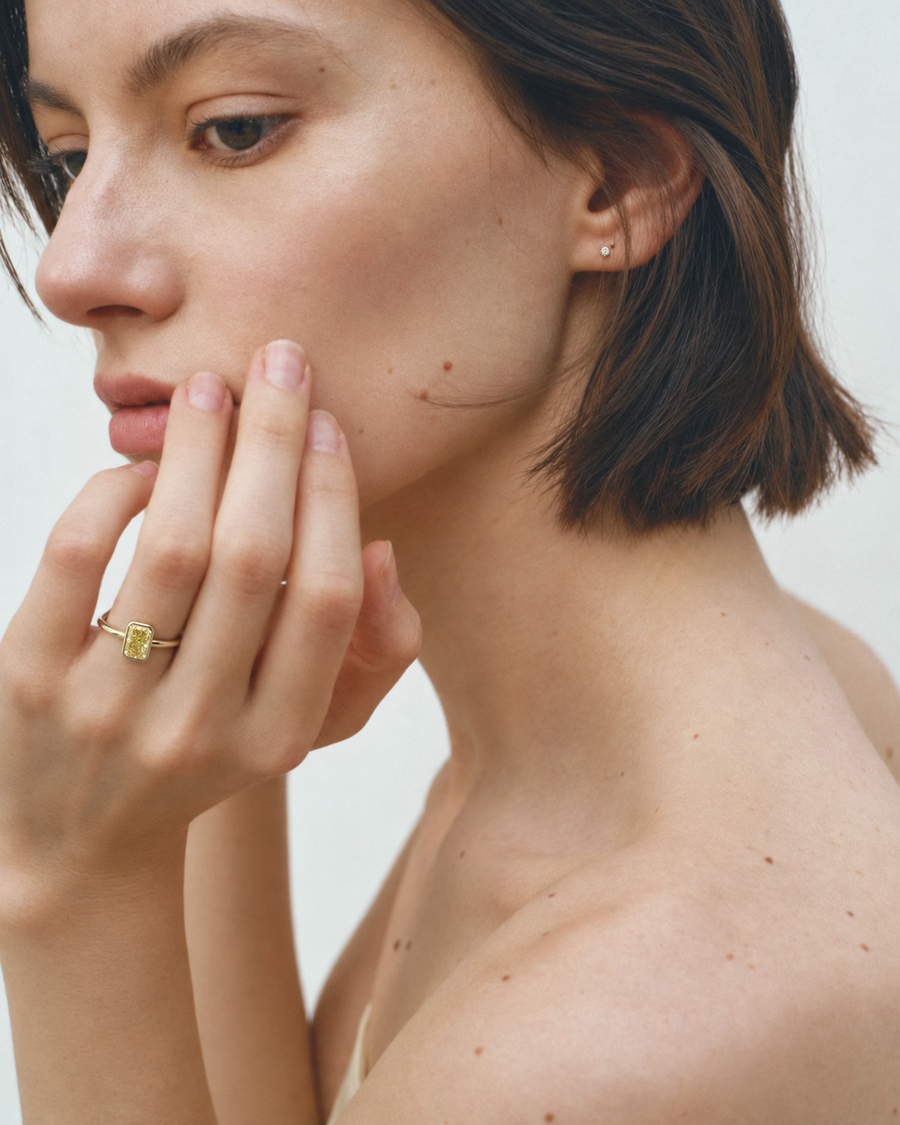
Orbit Yellow Bezel Ring — 18K Yellow Gold Lab-Grown Diamond Ring - 0.473 ct Total

Lien Lumière Necklace — 14K Gold Lab-Grown Diamond Necklace - 0.482 ct Total

18K Yellow Gold Lab Grown Diamond Ring - 0.686 ct Total

Lumière Oval Pendant — 14K White Gold Oval Modified Brilliant Lab-Grown Diamond Necklace - 1.52 ct Total


One note at a time.
New writing, new stones. Nothing else. Unsubscribe whenever you like.