
September 2, 2026
How to Wear Fine Jewelry to Work
Fine jewelry works at the office when it is small enough to be seen twice and never once. A pair of studs, one ring, one fine chain: three points, no more.
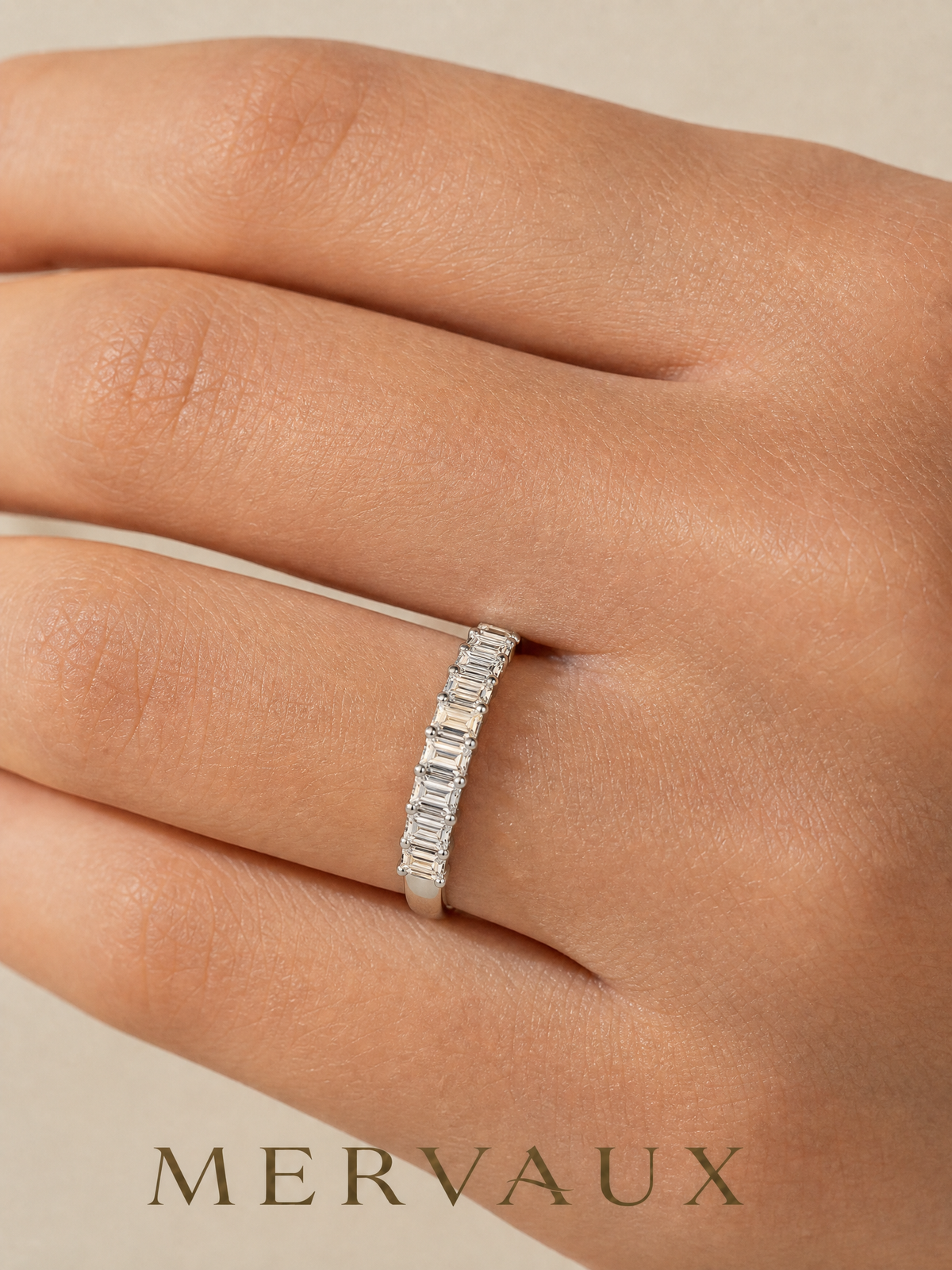
Fine jewelry works at the office when it is small enough to be seen twice and never once. A pair of studs, one ring, one fine chain: three points, all below the volume at which a piece becomes the first thing said about you. Anything past three starts doing work you did not ask it to do.
This is the question we get asked most often by people who have just bought their first real piece, and the honest version of the answer has less to do with taste than with how a room reads a hand.

A woman in a dark blazer and a white tee sitting with her arms folded, a single plain band on one hand and nothing else visible.
Where a room actually looks
In a meeting, hands are the most watched part of a person after the face. They are above the table, they move while you speak, and they are the only place jewelry is seen in motion rather than at rest.
That has two consequences. The first is that a ring is the loudest piece you can wear at work, regardless of size, because it is the one that moves. The second is that earrings are the quietest, because a stud sits still, is read once, and is then filed as part of the face rather than as an object.
A chain sits in between, and depends entirely on the neckline. Under a closed collar it is invisible and does nothing. On an open collar it becomes a third point on the same vertical line as the face, which is either a good decision or an accident.
The three-point limit, and why it holds
Three points is not a style rule. It is the number of distinct bright objects a person can register without starting to add them up.
At one or two points, jewelry reads as a detail of the person. At three it still does. At four it becomes a set, which means it becomes deliberate, which means it is now a subject. The subject may be perfectly welcome at dinner and is rarely what you want in a client meeting.
The points do not have to be equal. A larger piece counts as a point, not as two, so a 1.161 ct pair of round studs in solid 14K yellow and a plain band is still two points, and it is a stronger arrangement than four small things distributed across a hand.
Where the count goes wrong is stacking. Two bands worn together on one finger read as one point on a hand at rest and as two the moment the hand moves, which is why a stack that looked correct at the mirror looks busy on video.
What to wear on a hand that has to work
Office wear is not gentle. Keyboards, bag handles, doors, laptops in and out of sleeves. That is real mechanical load and it is the reason the correct office ring is usually the lowest one you own.
A low profile matters more than a small stone. A modest stone set high catches on wool and turns on the finger all day; a larger stone set close to the hand does neither. That is the entire argument for a bezel in a working environment, and the reason a 1 ct round in solid 14K yellow gold is easier to wear through a Wednesday than something taller at half the weight.
Metal follows the same logic. 14K is the harder alloy and holds a finish better through daily contact, which is why the pieces that survive an office are more often solid 14K than 18K. Not a rule, but a strong tendency.

A ring resting on a black leather portfolio beside a coffee cup on a stone table, the piece off the hand for a moment mid-day.
Video changes the arithmetic
A remote meeting frames you from the sternum up, in a single flat light source, usually a screen. Three things change.
Hands leave the frame for most of the call and re-enter unpredictably, so a ring goes from being the loudest piece in a room to being an intermittent flash. Earrings become the piece that is visible for the entire hour. And the light is diffuse and frontal, which is the worst possible condition for a brilliant cut: a round stone under flat frontal light returns very little and reads as a small dark point rather than as brightness.
The practical version of this is that the piece which photographs best on a call is a piece with surface rather than sparkle. Polished metal returns a flat source; a faceted stone does not. A plain chain or a pendant with visible metal holds a video frame better than a stone of the same value.
Two situations where the advice inverts
Client-facing work where being remembered is part of the job is the obvious one. In that setting the three-point limit is not a target, it is a floor, and one deliberate larger piece does more than three careful small ones. A colored stone is the most efficient version of this, because color is legible at a distance where carat weight is not.
The other is a workplace with a genuine safety or hygiene rule, where the answer is not to wear less but to wear none, and to move everything to the ears, which are the only category unaffected by hand protocols.
Where this works against us
The most useful advice we can give about jewelry at work is that most of it should be quiet, and quiet pieces cost less than loud ones. We are aware of what that means.
There is a second and more uncomfortable point. A significant amount of writing in this category frames workplace jewelry as a tool for being taken seriously, and quietly promises that the right piece changes how a room treats you. We do not think that is true, and we are not going to write it. What a well chosen piece does is remove a distraction. It does not add authority, and anyone selling you authority in a box is selling you something they cannot deliver.
Figure 3
A slim bezel-set bangle in solid 14K yellow gold, a piece low enough to pass under a sleeve without catching.
The interview is a different problem
An interview compresses everything above into forty minutes with a stranger who is reading you at speed, and the calculation changes in one specific way: there is no accumulated context to absorb an unusual piece.
In an ongoing workplace, a distinctive piece is read against everything else already known about you. In an interview it is read on its own, and anything that invites a comment is spending time you have a fixed amount of. That argues for the lowest-information version of everything: studs, one plain band, nothing at the throat unless the neckline is open and a chain is what stops it reading as empty.
The exception is genuine. If the work is in a field where visual judgment is part of the job, wearing nothing is also a statement, and a considered piece does more than an absence would. The distinction is whether anyone in the room is being paid to notice.
Either way, a piece worn to an interview should be a piece already worn for weeks. New jewelry is fidgeted with, and fidgeting is the only thing on this page that a room reliably reads as nerves.
The rule
Wear what you would forget you had on by ten in the morning. That is the working definition of office-appropriate, and it is a better test than any list of what is and is not allowed.
A piece you keep checking is a piece that is too high, too loose or too new. A piece you notice only when someone else does is correctly chosen. That standard produces the same answer as every paragraph above, and it does not require you to know anything about settings: low, few, and worn often enough to have stopped being an event. Which is the whole argument for wearing it on an ordinary day rather than saving it, and the reason most of what we make is built at that scale rather than the other one.
Last updated September 2026.
In the collection

Orbit Yellow Bezel Ring — 18K Yellow Gold Lab-Grown Diamond Ring - 0.473 ct Total

Lien Lumière Necklace — 14K Gold Lab-Grown Diamond Necklace - 0.482 ct Total

18K Yellow Gold Lab Grown Diamond Ring - 0.686 ct Total

Lumière Oval Pendant — 14K White Gold Oval Modified Brilliant Lab-Grown Diamond Necklace - 1.52 ct Total


One note at a time.
New writing, new stones. Nothing else. Unsubscribe whenever you like.