
September 2, 2026
Why a Diamond Looks Different in Every Photograph
A diamond looks different in every photograph because a photograph records one lighting condition, and a diamond is an instrument for converting light into an appearance.

A diamond looks different in every photograph because a photograph records one lighting condition and a diamond is an instrument for converting lighting conditions into an appearance. Change the number of light sources, their size or their angle, and you change what the stone does. Nothing about the stone has changed at all.
This is the single largest source of confusion in buying a stone from an image, and it is worth understanding as physics rather than as a suspicion about photography, because once you know what each kind of light does you can read a photograph for what it is actually telling you.

A close profile in daylight with a large round diamond stud at the ear, one hard source and a single set of reflections.
What a brilliant cut is actually doing
A round brilliant has fifty-seven facets and each one is a small mirror. Light enters through the crown, reflects off the pavilion facets and exits back through the crown toward the viewer. What you see as sparkle is not the stone glowing. It is a set of individual light sources being reflected at you, one facet at a time, from different angles.
That has an immediate consequence: a stone can only return as many bright points as there are light sources to return. A room with one lamp produces a stone with a few bright flashes. A room with nine small ceiling lights produces a stone that looks alive. It is the same stone.
It also explains why a diamond looks dead outdoors under cloud. An overcast sky is not a source; it is a wash arriving from everywhere, and a facet reflecting a uniform gray sky returns uniform gray. There is nothing to divide.
The four lighting conditions and what each one hides
Product lighting. Several small, hard sources at deliberate angles, which is the maximum-performance condition. Every stone looks its best and, more importantly, the differences between stones compress. Two stones a full grade apart look nearly identical here. This is the condition almost every image you have ever seen of a diamond was made in, including ours.
Direct sun. One very small, very hard source. This produces the most dramatic result and the most fire: fewer flashes, but each one is intense and throws spectral color. Direct sun is the condition that separates a well cut stone from a poorly cut one most clearly, because a poor cut leaks light rather than returning it.
Overcast or an office ceiling. Diffuse light from a large area. The stone reads as a small dark shape and the setting becomes the visible object. This is the condition most of a working day is spent in, which is why the piece that reads well at a desk is often the one with visible metal rather than the one with the better stone.
A screen. Flat, frontal, single, large. The worst case for a brilliant cut, and increasingly the condition in which people are seen most. This is where a colored stone behaves completely differently, because color does not depend on returning a small source and holds in flat light where brightness disappears.

A hand at the collarbone in soft window light, a ring and a small stud both reading as shape rather than as sparkle.
Why the same ring photographs differently on two people
Skin is a light source. It is a large, close, warm reflector sitting directly under the stone, and it contributes to what the pavilion returns.
A stone photographed against warm skin picks up warmth in the facets facing downward, which is why a colorless stone can look faintly warm on one hand and neutral on another. This is not a difference in the stone and it is not a fault in the photograph. It is the same reason a yellow gold setting warms a stone slightly and a white metal setting does not.
Nail polish, a sleeve color, a tablecloth: all of them are within reflecting distance of a stone worn on a hand, and all of them show up in the stone. A ring photographed over a white table and the same ring photographed over dark wood are two different pictures.
How to read a photograph you are buying from
Four practical readings.
Look at the number of bright points, not their brightness. Many small distinct flashes indicates a stone that is dividing light across the whole crown. A few large bright areas can mean a shallow stone returning light in blocks, which looks impressive in a still and flat in a room.
Look for a dark center. A stone cut too deep loses light out of the pavilion and shows a dark area under the table. In product lighting this is often the only visible symptom of a cut problem.
Prefer video, strongly. Fifteen seconds of a stone moving through changing angles tells you more than any still image, because it shows the transition between facets rather than one frozen instant. This is the one thing worth insisting on.
Read the cut grade before the color grade. Everything above is a description of cut. The report is where cut is stated plainly, and reading it in the right order is faster than trying to infer it from pictures.
Shape changes all of this
The rules above describe a round brilliant. Other shapes behave differently enough that a photograph of one is not comparable to a photograph of the other.
Step cuts, meaning asscher and emerald cuts, have long parallel facets rather than many small ones. They do not scatter light; they return it in broad flashes, which photographs as calm rather than brilliant, and they show inclusions much more readily. An oval has a bow-tie, a dark band across the center that varies from invisible to obvious and is not stated anywhere on the report. It shows in video and often not in a still, which is the specific reason to watch an oval move.
Where this works against us
Everything above applies to our own photography. Our images are made under lighting chosen to show a stone performing, the stones are shown at magnifications far past what a hand is seen at, and the difference between a very good stone and an excellent one is not visible in any of them.
The stone in your hand on a gray Wednesday will not look like the picture. That is not a defect in the stone or a trick in the image; it is the difference between nine sources and none. But it does mean an image is a poor instrument for comparing two stones, and we would rather point you at the report and the video than at our own photographs.

A backlit portrait in bright daylight with a plain band on the hand, the metal carrying the light where a stone would not.
The rule
Judge a stone in the worst light available, not the best. A stone that holds up under a flat overcast sky or an office ceiling will be extraordinary in a lamp-lit room. A stone chosen under product lighting has been chosen at the one condition it will rarely meet again.
Practically, that means the sequence is video, then report, then photographs, in that order and never the reverse. It also means that if a piece has to work at a desk and on a screen for most of its life, the decision is not really about the stone at all: it is about visible metal, low settings and color, all of which survive the light that a brilliant cut cannot use. Which is a longer way of saying what a single day of changing light demonstrates on any piece you already own.
Last updated September 2026.
In the collection
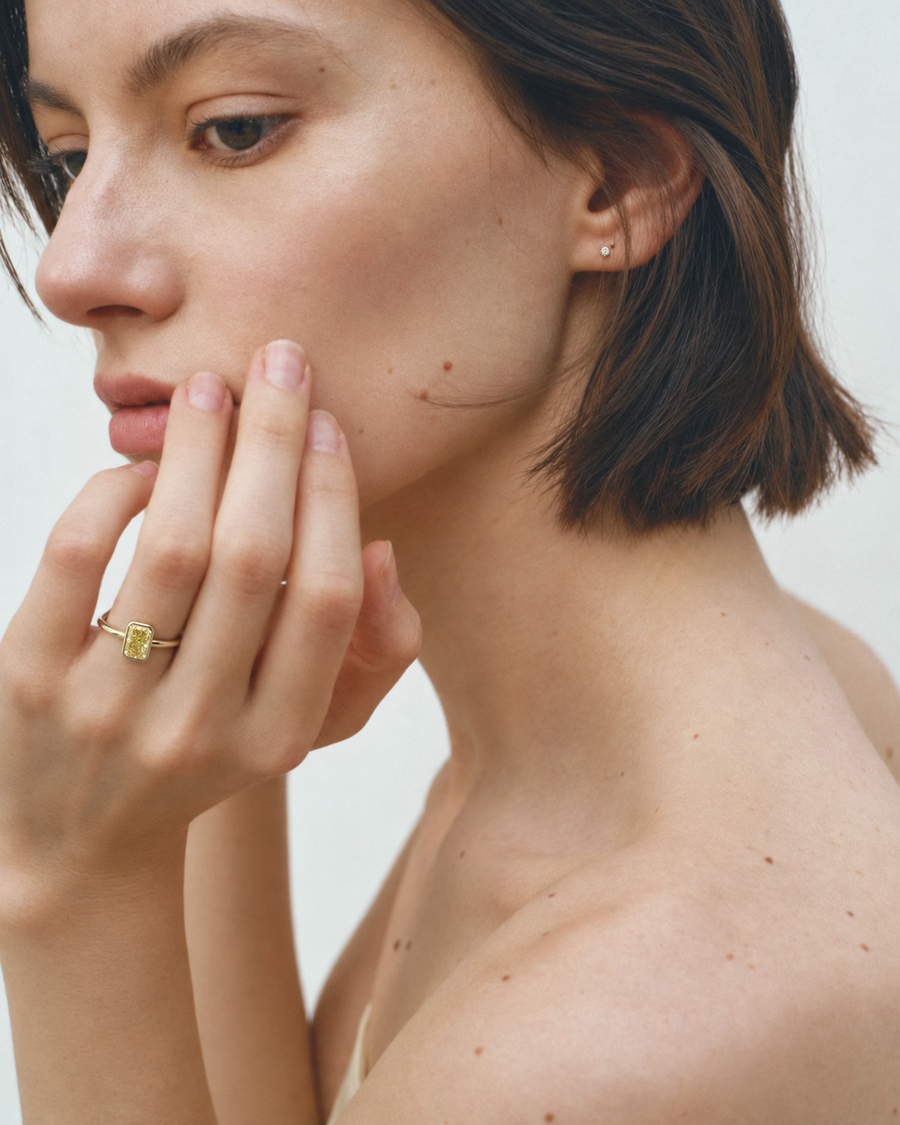
Orbit Yellow Bezel Ring — 18K Yellow Gold Lab-Grown Diamond Ring - 0.473 ct Total

Lien Lumière Necklace — 14K Gold Lab-Grown Diamond Necklace - 0.482 ct Total

18K Yellow Gold Lab Grown Diamond Ring - 0.686 ct Total

Lumière Oval Pendant — 14K White Gold Oval Modified Brilliant Lab-Grown Diamond Necklace - 1.52 ct Total


One note at a time.
New writing, new stones. Nothing else. Unsubscribe whenever you like.