August 27, 2026
Does an Oval Diamond Look Bigger Than a Round?
An oval looks bigger than a round of the same carat weight, but by roughly 5 to 10 percent of face-up area. The gain is length, not width, and it does not read as a full size larger.
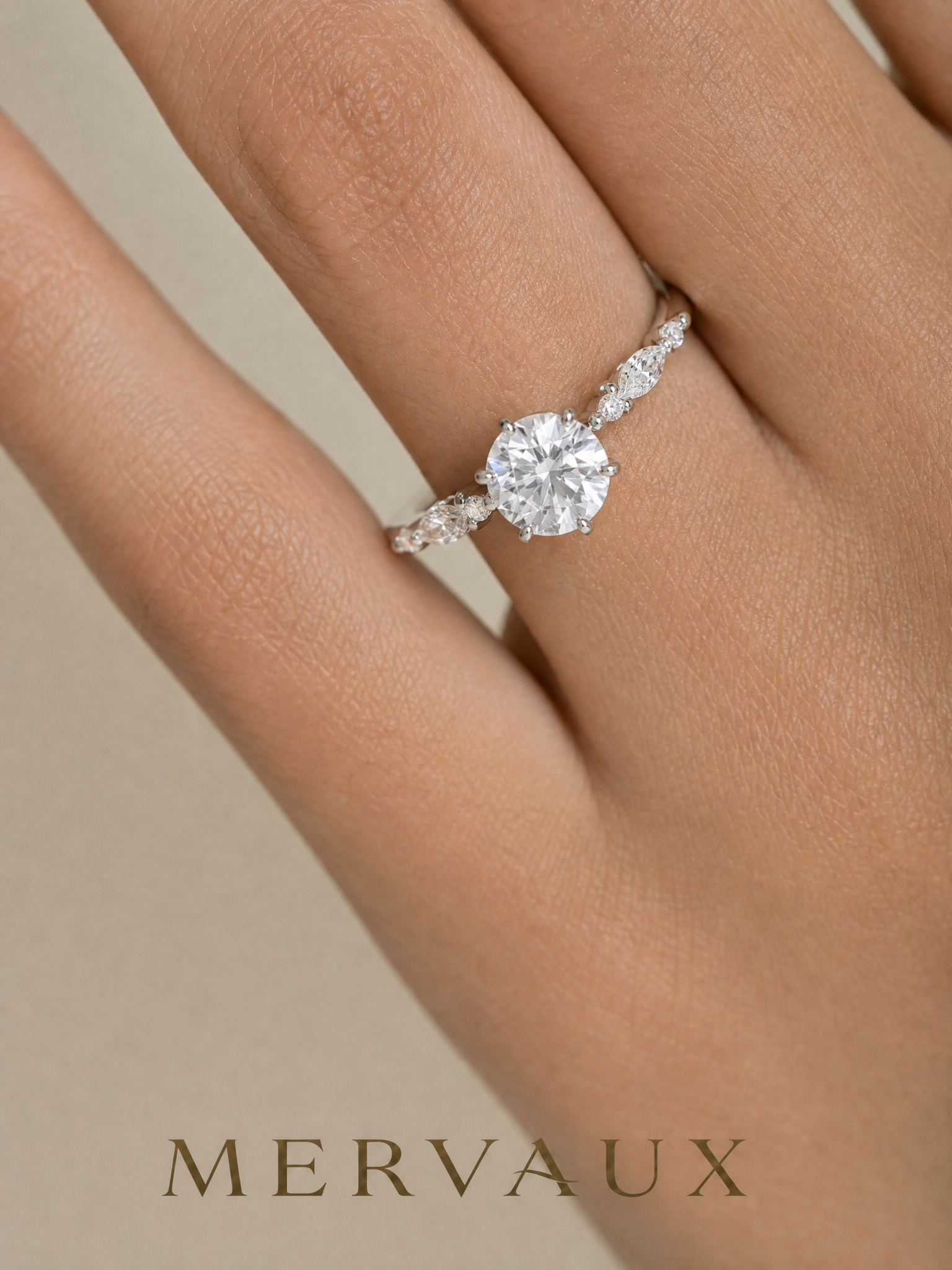
Yes, an oval looks bigger than a round of the same carat weight, but by less than most people expect. At equal weight an oval shows roughly 5 to 10 percent more face-up area, and it reads longer on the finger. It does not look a full size larger. The gain is length. It is not width.
How much bigger does an oval actually look at the same carat weight?
The millimeter numbers
At the same carat weight, a well-proportioned oval covers about 8 to 11 percent more surface when you look straight down at it.
| Carat weight | Round diameter | Oval length x width | Round face-up area | Oval face-up area | Oval advantage |
|---|---|---|---|---|---|
| 1.00 ct | about 6.4 mm | about 8.0 x 5.7 mm | about 32 mm² | about 36 mm² | about 11% |
| 1.50 ct | about 7.3 mm | about 9.1 x 6.5 mm | about 42 mm² | about 47 mm² | about 10% |
| 2.00 ct | about 8.1 mm | about 10.0 x 7.1 mm | about 52 mm² | about 56 mm² | about 8% |
| 3.00 ct | about 9.3 mm | about 11.5 x 8.2 mm | about 67 mm² | about 74 mm² | about 10% |
Every figure here is approximate. Two stones of identical weight can differ by half a millimeter in any direction depending on how deep the cutter went, how thick the girdle was left, and how much of the original rough the cutter was trying to keep.
Why it reads as length, not size
Look at the 2 carat row again. The round is 8.1 mm across in every direction. The oval is 10.0 mm in one direction and 7.1 mm in the other. Against the round, the oval gains about 1.9 mm of length and gives up about 1.0 mm of width.
Why does an oval look bigger than a round at all?
Where each shape keeps its weight
A round brilliant is cut to return light, and returning light in a round requires depth. A well-cut round runs about 59 to 62.5 percent as deep as it is wide, and a large share of that weight sits in the pavilion, below the girdle, where you never see it.
An oval is a modified brilliant stretched along one axis. Stretching the outline adds surface without adding a proportional amount of pavilion, so more of the weight ends up in the part of the stone you can actually see.
The shallow stone trap
A shallow stone spreads more and performs worse.
Cut a stone too shallow and light entering the crown passes through the pavilion instead of bouncing back to your eye. It will measure larger. It will look duller. If you are shopping two ovals of the same weight and one is noticeably wider, ask what its depth percentage is before assuming the wider one is the better buy.
Our own 3.02 ct D VS1 oval measures 11.45 by 8.15 by 5.15 millimeters, which puts it about 63 percent deep against its width, marginally deeper than the 58 to 62 percent band usually quoted as ideal. We would rather say that than let you find it on the report.
What is the bow-tie in an oval, and how much does it matter?
The bow-tie is a dark band running across the narrow axis of an oval. It appears because your own head blocks the light those facets need in order to return anything to your eye.
Every oval has one. GIA states plainly that "due to the nature of the shape and faceting pattern, some degree of bow tie is always present" in an oval, and that a well-cut oval only minimizes it.
It is not on the report. No lab grades it, in any current system.
How to judge one, in a photograph and in person
From a still photograph you cannot, reliably: studio lighting fills shadows from every direction, which is exactly what a bow-tie is.
- Rotate the stone slowly in a 360 degree video and watch whether the dark band stays fixed, or breaks up into flashes.
- Look at the proportion of the face it covers. A shadow crossing under a fifth of the surface is normal. One crossing a third or more, and staying that way as the stone turns, is a cutting problem.
- In person, take it out from under the display lighting and into diffuse daylight. A well-cut oval's dark band moves and refills with light. A poor one holds a static gray bar.
How much it should change your decision
A faint bow-tie is normal for the shape. A heavy one is a permanent flaw you will notice every time you look down. GIA's 2024 study of oval, pear and marquise diamonds found that by 2023, nearly 90 percent of ovals submitted to the lab had no belly mains, a faceting change that reduces bow-tie severity.
Why do two ovals of the same carat weight look completely different?
Length-to-width ratio, and what each range reads as
Length-to-width ratio is the oval's length divided by its width. It is printed on the report, and it changes the character of the stone more than any other number on the page. If you have not read an IGI report before, that is where the measurements sit.
| L/W ratio | How it reads | Trade-offs |
|---|---|---|
| 1.20 to 1.30 | Nearly round, plump, soft | Least elongating on the finger; can be mistaken for a poorly cut round |
| 1.30 to 1.40 | Rounded oval, generous width | GIA describes this range as the more rounded look; bow-ties tend to be narrower |
| 1.40 to 1.50 | Classic oval | GIA calls this the most popular range; the standard modern proportion |
| 1.50 to 1.60 | Elongated, dramatic | Strongest finger-lengthening effect; bow-ties tend to widen |
| Above 1.60 | Very long, closer to a marquise silhouette | Reads as its own shape; hard to match with a standard setting |
Same weight, different object
Take two 2.00 ct ovals. One at a 1.30 ratio measures roughly 9.4 by 7.2 mm. One at a 1.55 ratio measures roughly 10.7 by 6.9 mm. Same weight. Same face-up area, within a rounding error. Completely different objects on a hand.
How do the two shapes behave in a setting and in daily wear?
Prong count and where the prongs sit
A round brilliant is symmetrical, so prongs can go anywhere on the circumference: four show more stone, six hold more securely. An oval has no such freedom. Four prongs on an oval, set at the shoulders, leave the tips of the long axis exposed. Six, with a pair at each end, protect the vulnerable geometry. If a jeweler proposes four on an oval above about 2 carats, ask them to justify it. You can see how both sit in our rings.
What actually catches
Snagging is about height, not shape. A high-set solitaire of either shape will find every sweater you own. Where the shapes differ is at the ends: a round has none, and an oval has two that sit slightly proud and take the impact when a hand meets a door frame. That is where an oval chips.
How marquise and pear compare
Both take the elongation further and pay for it: a sharp tip concentrates any impact, so both need V-shaped prongs rather than standard ones. Our marquise stones carry two points; the pear shapes we hold carry one, at half the exposure.
Smaller hand, larger hand
On a narrower finger, an oval above about 1.50 can overhang the sides. A round of the same weight, or an oval nearer 1.35, sits inside the finger's width. On a wider finger the reverse: a round can read as a dot, and an oval fills the space between the knuckles. If you want help narrowing it, start with what the stone has to do.
Which shape holds up better under sparkle?
Round is graded to a tighter standard
Round wins here. A round brilliant is the only shape whose light behavior can be predicted from its measurements. GIA states it directly: oval diamonds, being fancy shapes, do not receive a cut grade. They get polish and symmetry, and nothing more.
What the labs actually do for ovals
IGI has issued cut grades for fancy shapes since 2022, on a four-step scale from Excellent to Poor. IGI's own description is that fancy shapes are assessed on polish, symmetry, craftsmanship and light return, while round brilliants get polish, symmetry, proportions and light performance with separate readings for brightness, fire and contrast. Those are not the same instrument.
GIA has said it will introduce cut grades for oval, marquise and pear diamonds in 2027. Until then, a GIA-graded oval carries no cut grade at all.
Every stone we sell carries an IGI report. Our 2.02 ct D VS1 oval carries IGI Cut, Polish and Symmetry all at Excellent, the top of the fancy-shape scale. Our 2.05 ct D VS1 round carries an Ideal cut grade, an older and different standard. The two labs are not interchangeable, which we cover in IGI vs GIA.
A top-graded round is close to a guarantee of good light performance. A top-graded oval is a strong signal that still leaves you responsible for looking at the stone. If you would rather not spend an evening comparing videos, buy the round. Our 2.01 ct D VVS2 round carries an Ideal cut grade and leaves nothing for you to adjudicate by eye.
Where this answer works against us
You are reading this on a jewelry brand's site, so here is the position plainly.
Our inventory cannot be the reason for any recommendation here, because there is barely any inventory to point at. As of August 2026 we hold two loose round stones and three loose ovals. Five stones. That is not a selection, and it would be dishonest to build a shape argument on top of it. If you want a round brilliant with a top cut grade and buy it somewhere else because we do not have the one you want, you have made a good decision.
The bow-tie is ungraded and it is on you. No report tells you how bad it is. We can send video, and we do, but no seller can remove the fact that you are making a visual judgment the grading system does not make for you.
Questions people ask before they choose
Does an oval look bigger than a round of the same carat? Yes, by roughly 5 to 10 percent of face-up area, almost all of it gained in length. At 2 carats the oval is about 1.9 mm longer and about 1.0 mm narrower than the round.
Is an oval cheaper than a round of the same carat weight? Generally yes, for the same color and clarity, because rounds waste more of the original rough and carry the strongest demand. We do not publish figures in articles, since prices here have been moving for several years. Current numbers sit on the round and oval collection pages, and what actually drives them is covered in our guide to what moves the price of a 2 carat stone.
Do all oval diamonds have a bow-tie? Yes. GIA states some degree of bow-tie is always present in the shape. The question is never whether, only how severe.
The rule to take away
Choose the round if you want the stone to be measurably right and would rather not judge it yourself. Choose the oval if you want the finger to read longer and you are willing to spend twenty minutes with a rotating video before you commit.
The one thing not to do is choose the oval expecting a bigger diamond. It is the same size of diamond arranged along one axis instead of spread evenly. If size is genuinely the point, the honest lever is carat weight, and it always was.
Everything we sell is graded before it is set, and the stone-by-stone detail sits on our diamonds page.
In the collection
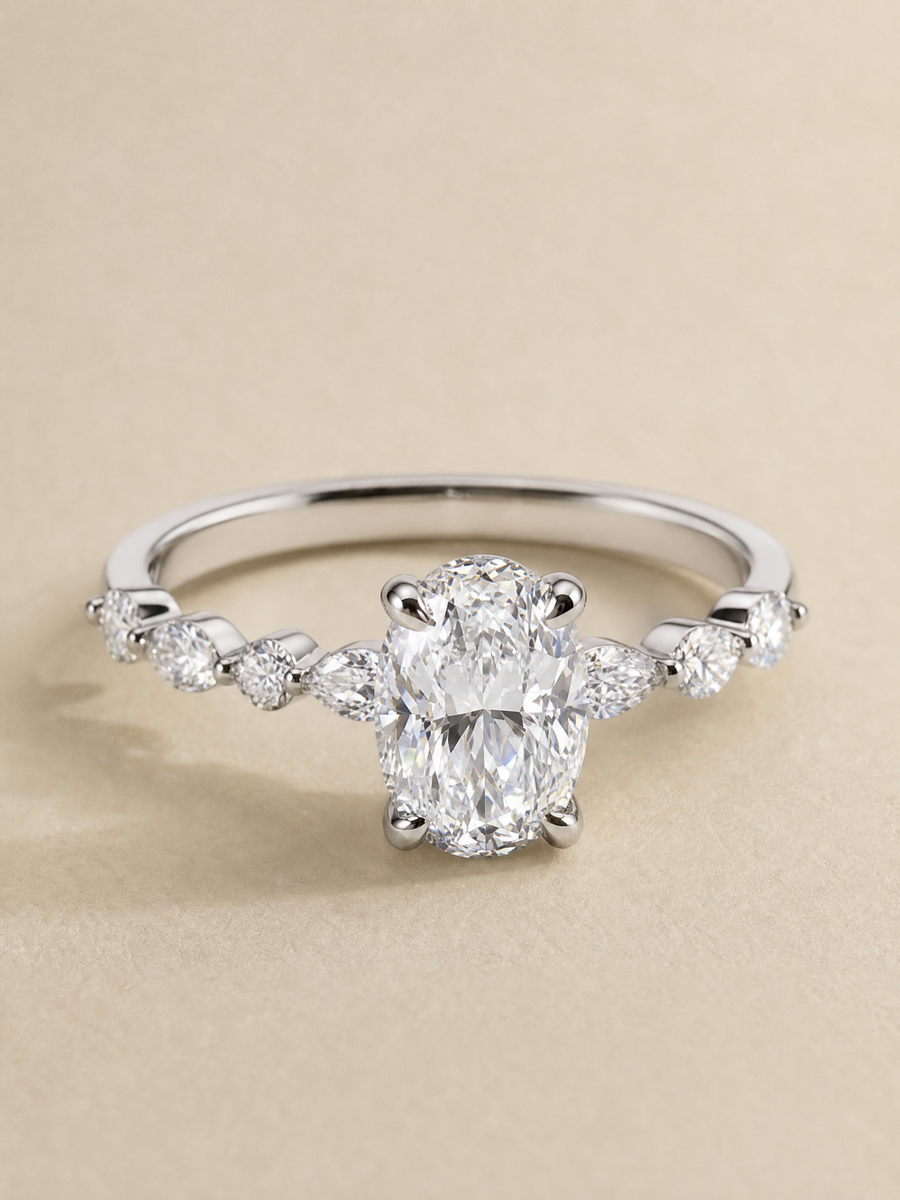
Platinum 950 Oval Brilliant Lab-Grown Diamond Ring - 1.22 ct Total
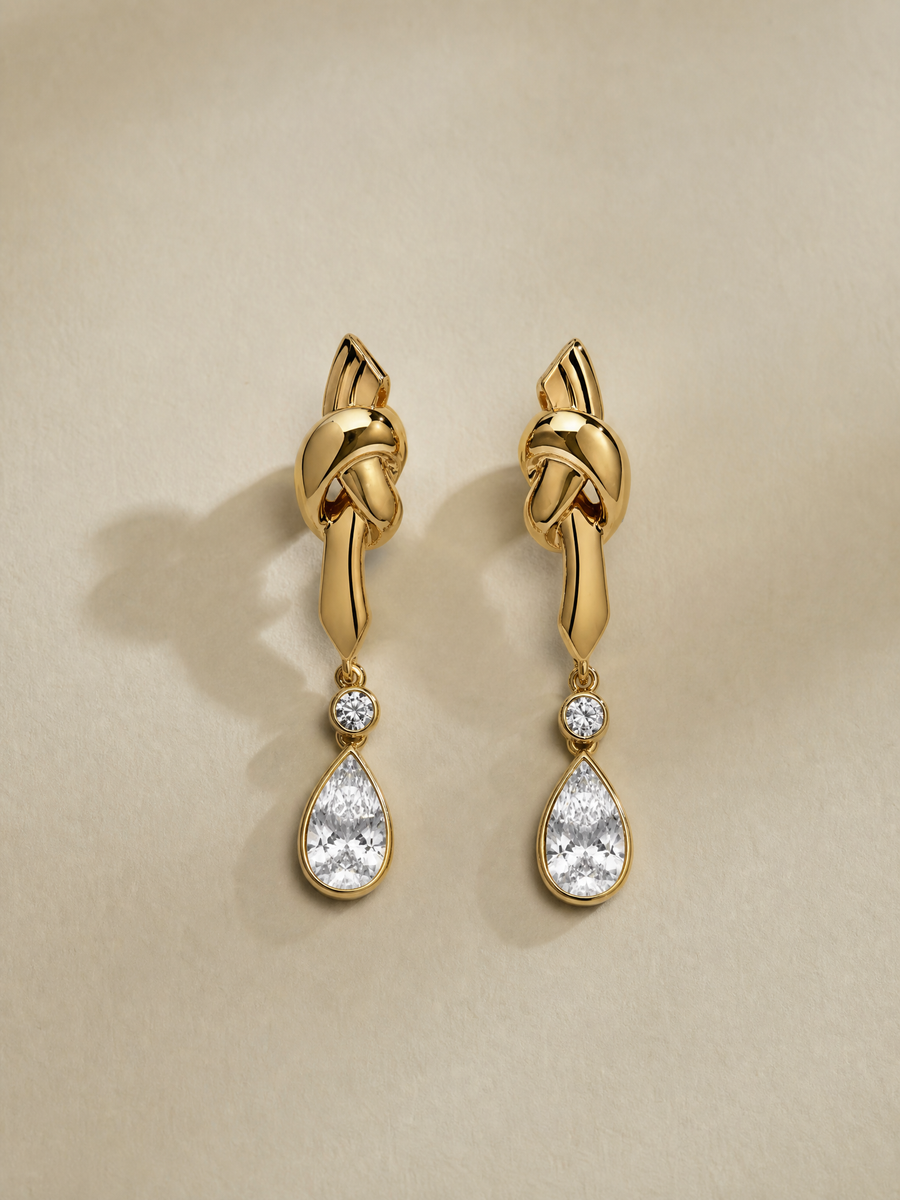
14K Yellow Gold Pear Lab-Grown Diamond Stud Earrings - 2.407 ct Total
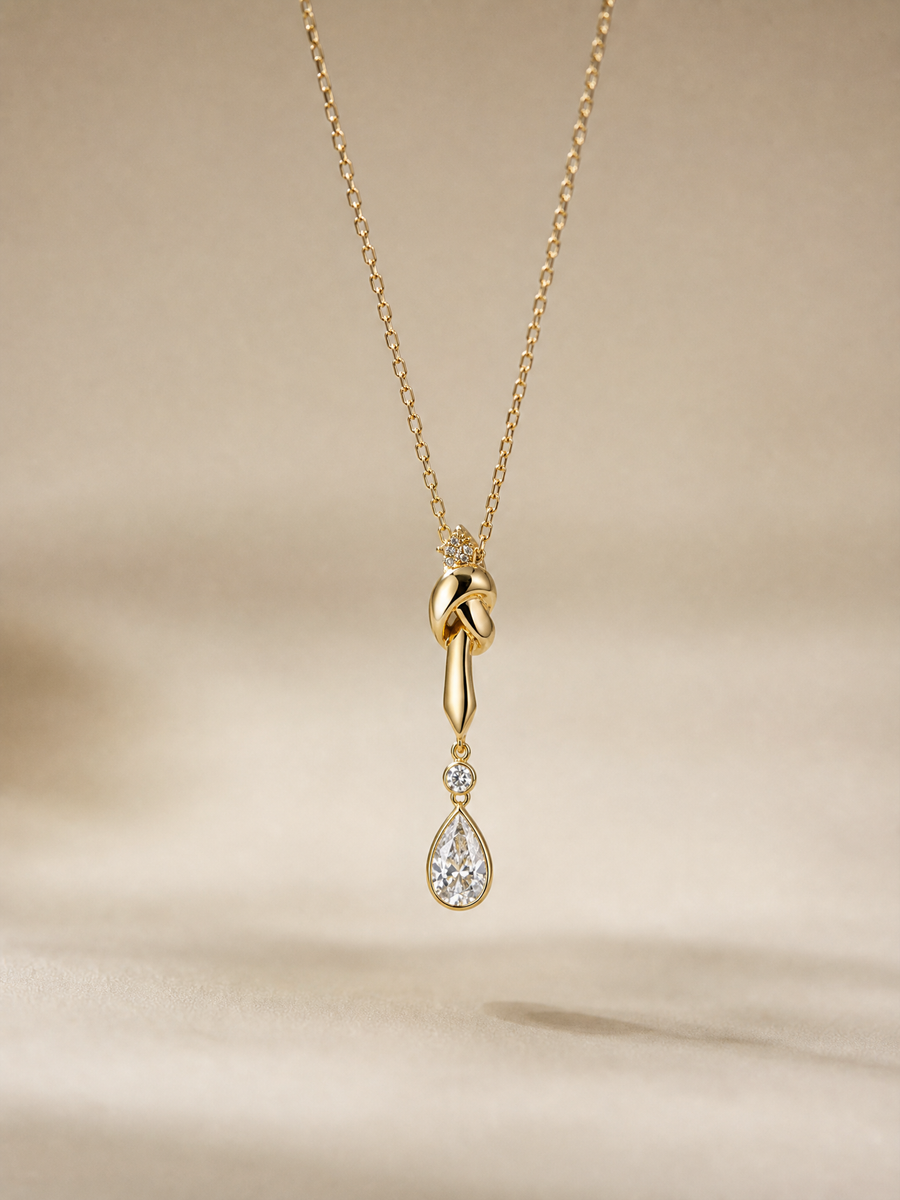
14K Yellow Gold Round Lab-Grown Diamond Necklace - 2.209 ct Total
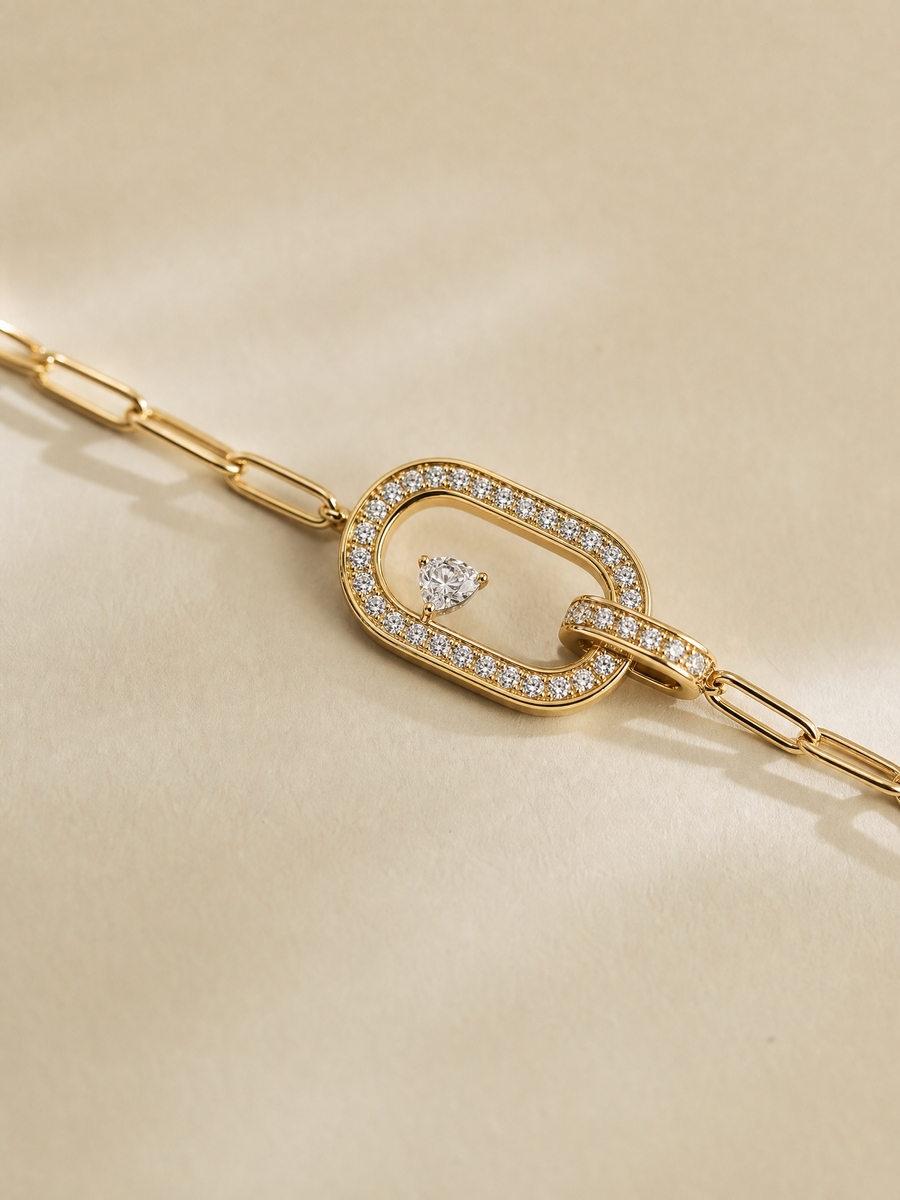
14K Yellow Gold Round Lab-Grown Diamond Bracelet - 0.633 ct Total
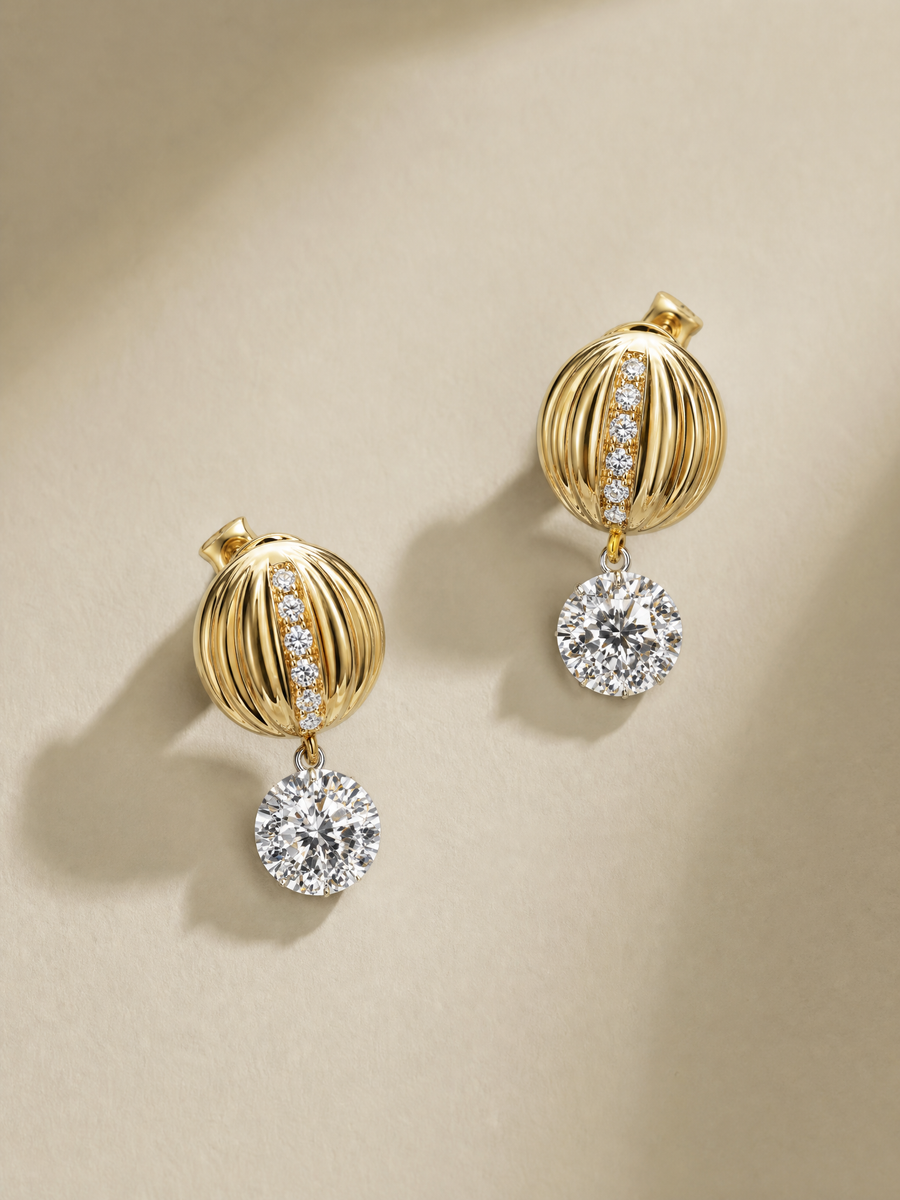
14K Two-Tone Gold Round Lab-Grown Diamond Stud Earrings - 1.654 ct Total
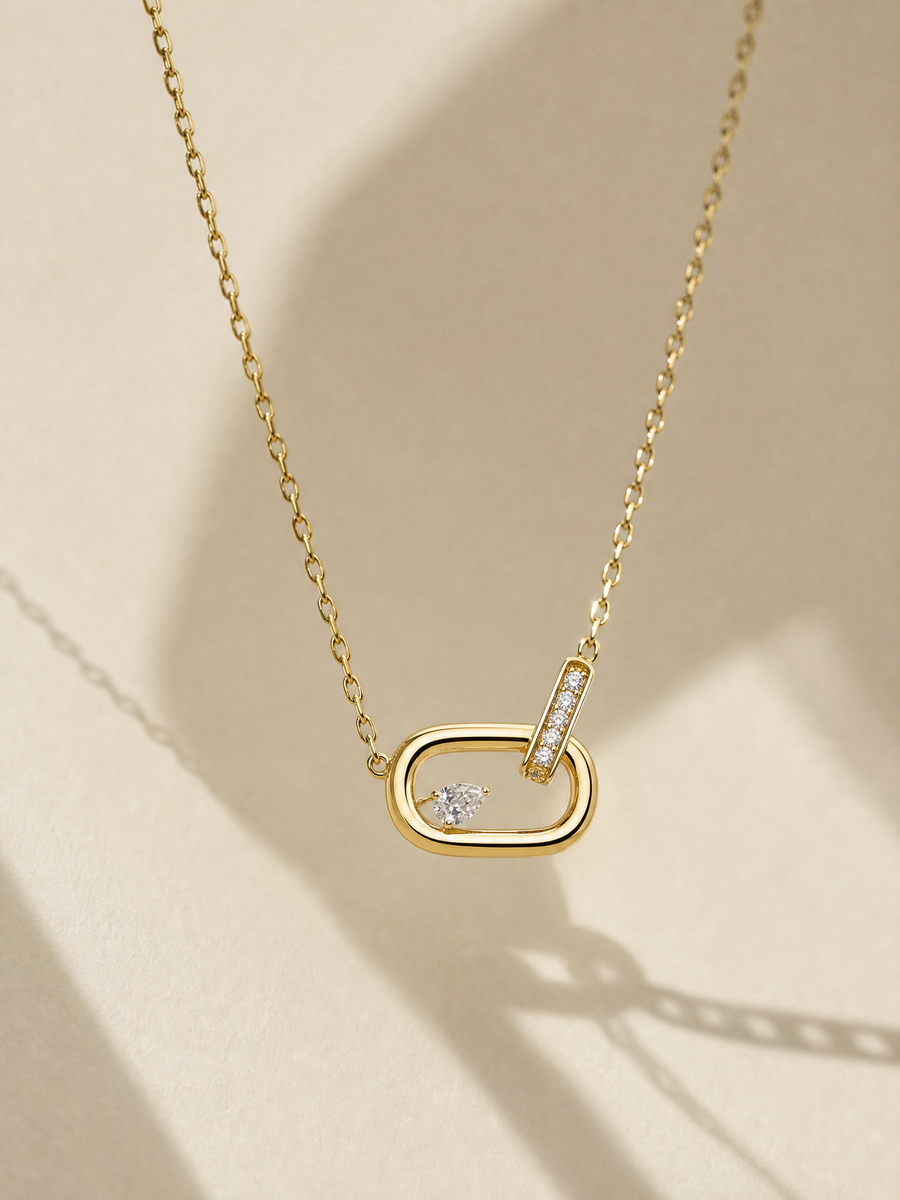
14K Yellow Gold Pear Lab-Grown Diamond Necklace - 0.245 ct Total
One note at a time.
New writing, new stones. Nothing else. Unsubscribe whenever you like.