
September 2, 2026
What Fine Jewelry Actually Travels Well
The fine jewelry that travels well is the jewelry you can sleep, swim and go through security in without thinking about it. Everything else is better left at home.

The fine jewelry that travels well is the jewelry you can sleep, swim and go through security in without thinking about it. In practice that is a pair of studs, one ring low enough not to catch, and nothing that needs a clasp found behind your neck in an unfamiliar bathroom. Everything else is better left at home.
This is a packing question rather than a styling question, and the reason it is worth writing down is that the standard advice, take the pieces that go with everything, is answering the wrong problem. The problem on a trip is not coordination. It is that jewelry gets lost in transit far more often than at home, and it gets lost in a small number of very predictable ways.

A woman in a white sleeveless dress against a sunlit stone wall, wearing a fine chain and a single ring and carrying nothing else.
Where pieces are actually lost
Not stolen. Removed and not put back. That is nearly the whole category, and it happens in four places.
A hotel bathroom counter, where a ring comes off to wash and stays. A beach or a pool, where cold water shrinks a finger by enough that a ring that has never moved suddenly can. A bedside table in a room you are leaving at six in the morning. And a security tray, which is the only one where you will notice within minutes and still not get it back.
Every one of those is a moment when a piece comes off. So the single most effective travel decision is to bring pieces that do not need to come off, which rules out more than it sounds like it does.
Studs are the strongest category here by a wide margin. They go through security, they survive water, they can be slept in, and there is no point in the day when they are set down on a surface. A pair like the 0.317 ct rounds in solid 14K white gold can be put in before the flight and taken out at home a week later.
What water and sun actually do
Less than the internet suggests, and different from what people expect.
Chlorine and salt water do not harm a diamond. What they do is dull it, quickly, because both leave a film and diamond attracts anything oily or mineral. A stone that looked bright on the first morning of a trip looks flat by the third, and the cause is a coating rather than damage. Warm water, a drop of dish soap and a soft brush returns it entirely.
The real risk in water is dimensional. Cold water contracts a finger measurably, and a ring sized to a warm hand in a warm month is loose in a cold sea. This is the mechanism behind the majority of rings lost on holiday, and it has nothing to do with carelessness.
Sunscreen is the underrated one. It builds up in the space under a stone faster than anything else in ordinary life, and it is the reason a stone worn on a beach holiday needs cleaning twice a week rather than twice a month. It does not damage anything. It just fills the one place light has to get through.
Heat does nothing to a diamond or to solid gold at any temperature reachable on a holiday. Sudden temperature change is worth avoiding with any stone that has an inclusion near the surface, which is a real if uncommon concern and one more reason the cut and clarity fields on an IGI report are worth reading before a trip rather than after.

A person in a black silk shirt with arms folded, wearing one ring and a slim bracelet, both pieces staying on through the day.
What to leave behind
Three categories, and the reasoning is mechanical rather than precious.
Anything with a fine clasp. A clasp is done up quickly, in bad light, in a room you do not know. It is the piece most likely to be dropped and the piece most likely to fail, and the jump ring beside the clasp is where a chain parts. A pendant on a chain you never remove is fine. A chain you put on for dinner is a risk taken nightly.
Anything set high. Travel involves bags, straps, luggage handles and unfamiliar door frames. A high setting catches, and a caught prong is not always noticed. A low or bezel-set piece takes the same knocks and passes them into the metal.
Anything you have not worn for a full ordinary week. A trip is the worst possible time to learn that a ring turns on your finger or that an earring back is loose. Everything in the bag should already have proved itself at home.
What travels better than people expect
A single ring, worn continuously, is easier than no ring, because a ring in a bag is a ring that can be left in a room. The safest place for a ring on a trip is on the hand it was sized for.
A bracelet or bangle with a rigid form also does well, for the same reason a stud does: it goes on once. A 0.347 ct bangle in solid 14K yellow is not removed to wash hands and does not need a clasp done up.
And one genuinely counterintuitive item: a slightly larger stone travels better than a slightly smaller one, if both are set low. Holidays are the setting in which jewelry is photographed most and worn against the least clothing, and a piece that reads correctly against a bare collarbone in strong sun is generally a step up in scale from the one that reads correctly under a work shirt. A 1.01 ct round on solid 18K white gold is a different object outdoors than it is at a desk.
Where this works against us
The commercially convenient version of this article recommends a travel piece: something bought specifically for trips, worn a few times a year, ideally purchased in the weeks before one.
We do not think that piece exists. Jewelry bought for an unusual context is worn in the unusual context and nowhere else, and a piece worn four days a year is the least good version of anything in this catalog. If a trip has made you want something, buy it after you get back and choose it against your ordinary week instead.
The honest travel list is made almost entirely of things you already own and already wear. That is a poor argument for a purchase and it is what we actually believe.
Figure 3
A pear cut diamond solitaire on a plain gold band resting on cream silk, a low setting that takes a knock without catching.
Security, and the small habit that solves it
Airport security is the only place on a trip where a piece is removed under time pressure, in front of people, into a container that is about to move away from you on a belt. That combination is why the tray accounts for a disproportionate share of losses.
Almost none of it is necessary. Solid gold and platinum are not magnetic and do not set off a walk-through detector at the quantities anyone wears, and a diamond is not metal at all. A pair of studs, a chain and a ring pass through without any of it coming off. The removal is nearly always precautionary rather than required.
If something does have to come off, the habit that works is to put it in a zipped pocket of the bag rather than in the tray, before joining the queue rather than at the front of it. The failure is not carelessness at the machine; it is having no decided place for the piece to go, and deciding under pressure.
The same principle covers the rest of the trip. One named place in the room, chosen on the first evening, and everything goes back to it. A piece is lost when it is set down somewhere new.
The rule
Pack only what stays on. If a piece has to be taken off and put back on during the day, it is a piece that will spend part of the trip on a surface in a room you are about to leave.
That single test settles almost every question above: it selects studs over drop earrings, one ring over three, a rigid bangle over a fine chain, and low settings over high ones. It also has the pleasant side effect of producing a much smaller bag. Everything that survives the test is something already worn on an ordinary Tuesday, which is the point: the pieces that travel well are not travel pieces, they are just the ones that were already good at being worn.
Last updated September 2026.
In the collection
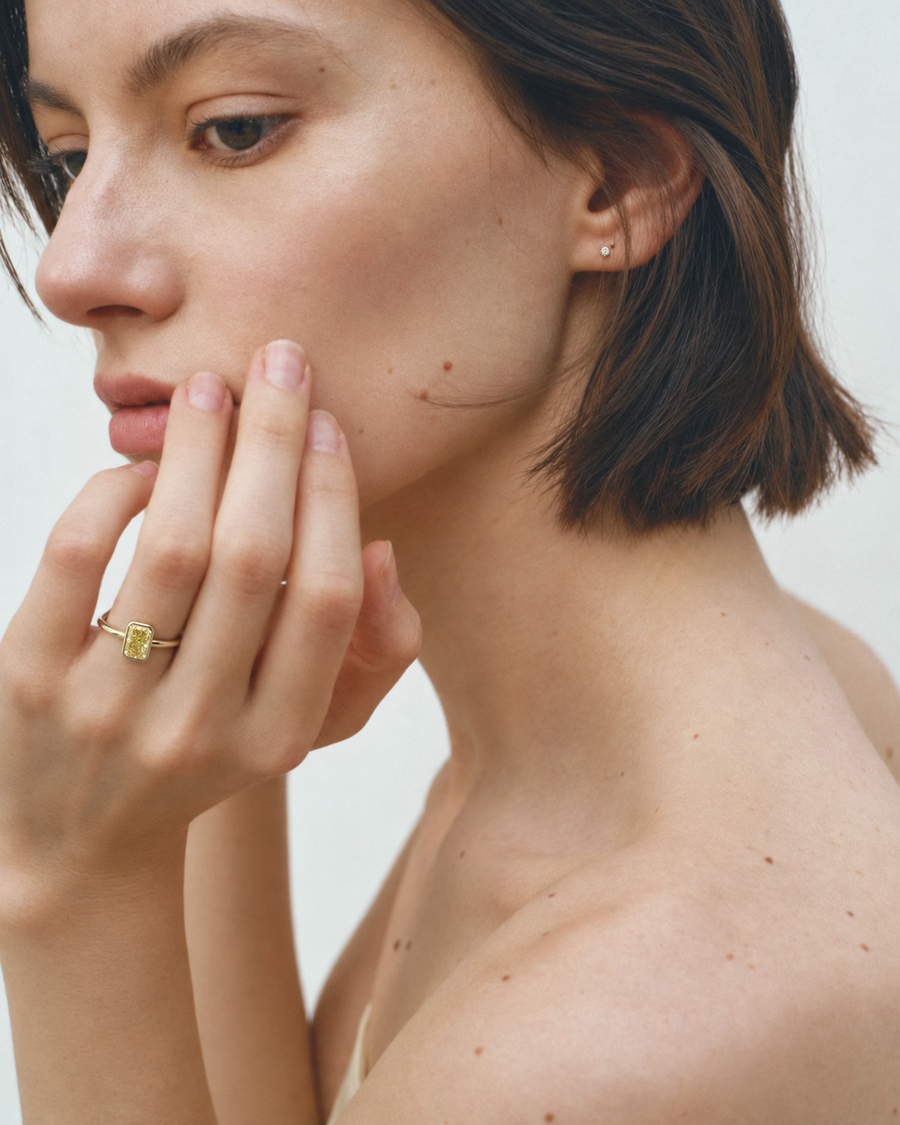
Orbit Yellow Bezel Ring — 18K Yellow Gold Lab-Grown Diamond Ring - 0.473 ct Total

Lien Lumière Necklace — 14K Gold Lab-Grown Diamond Necklace - 0.482 ct Total

18K Yellow Gold Lab Grown Diamond Ring - 0.686 ct Total

Lumière Oval Pendant — 14K White Gold Oval Modified Brilliant Lab-Grown Diamond Necklace - 1.52 ct Total


One note at a time.
New writing, new stones. Nothing else. Unsubscribe whenever you like.