
September 2, 2026
How Much to Spend on a First Real Piece
There is no correct amount to spend on a first piece, but there is a correct way to arrive at the number: decide how often it will be worn, then divide.

There is no correct amount to spend on a first piece of fine jewelry, but there is a correct way to arrive at the number: decide how often it will be worn, divide the price by that, and see whether the answer still sounds reasonable. A piece worn three hundred times a year is a different purchase from one worn four times, at the same price.
Every rule of thumb in this category, two months of salary and its descendants, is a marketing device with a known origin and no relationship to anything true about you. It survives because it removes a hard decision, and it removes it badly.

A woman in a dark blazer reading an open folder at a table, a ring on her hand and a small closed box set to one side.
Why the usual rules are useless
A salary multiple sets a budget from your income and tells you nothing about the object. Two people with identical incomes, one of whom will wear a ring daily for twenty years and one of whom will wear it to events, should not spend the same amount, and the rule cannot see the difference.
The second common rule, spend what it is worth to you, is worse, because it converts a decision into a loyalty test. Any number you land on can be criticized as insufficient feeling, which is precisely why the framing exists.
The useful frame is the one applied to a coat or a chair. What is the object, how long will it be in use, and what is the cost of the version that lasts against the version that does not. That produces different answers for different people and the answers are defensible.
What the price is actually made of
Four bands, and they behave very differently.
The stone. For lab grown diamonds this has been falling for several years and is still moving. We do not publish figures in articles because a number printed here is wrong within months and nobody returns to correct it. The collection pages are current; a sentence in a post is not.
The metal. Priced by weight and by market, and it is the only part of the object with a floor under it. A heavier band costs more and is also the reason a ring is still structurally sound in year fifteen.
The setting labor. Fixed, skilled, and unrelated to the value of what is being set. Setting a small stone well takes about as long as setting a large one.
Retail margin. Real, and everywhere.
The proportion that surprises people is how little of a modest ring is the stone. On a piece at the entry end of a ring collection, the stone is frequently the smallest of the four bands. This is the single most useful fact for anyone setting a budget, because it means the money saved by dropping a color grade is often much less than expected, while the money saved by choosing a lighter mount shows up immediately and costs you the piece's lifespan.
What is worth paying for and what is not
Three things repay the money at every level.
Cut. It decides how the stone behaves in a room and it is the only grade on the report that a stranger can perceive at conversational distance. Paying up for cut and down for color is the highest-return trade available in the whole category.
Metal weight and construction. The half of the object that does not fall in price and the half that decides whether the piece is wearable in a decade. What a decade actually does to a ring happens in the metal, not the stone.
Setting height, in the right direction. Low is not cheaper. It is often more work. It is also what makes a piece wearable daily rather than occasionally, which changes the arithmetic at the top of this article more than any other single decision.
And two things that reliably do not repay the money at the entry end. The first is clarity beyond eye-clean: the difference between VVS and VS is invisible without magnification on most shapes and sizes, and paying for it is paying for a line on a document. The second is the last color grade. A well cut stone one grade down, set in yellow or rose gold, is indistinguishable to everyone who is not holding a master set.

A woman in a brown wool coat over a white slip, a fine chain with one small stone at the throat, the scale most first purchases settle at.
The two-purchase question
A budget of any size splits two ways: one piece at the whole number, or two pieces at half.
Two is usually the better answer on a first purchase, and the reason is that you do not yet know your own taste at the level of detail that matters. Most people discover after a year that they want things lower, plainer and slightly smaller than they thought. Spending the entire budget before that discovery is the expensive path.
Two pieces also solve a problem one piece cannot: a pair of studs and one ring covers far more days than a single larger ring does, because they work in different situations. Building in an order is not a way of spending less. It is a way of spending in a sequence where each purchase is informed by the last.
The case for one piece is real and narrower: when a specific object is genuinely the thing wanted, and splitting the budget produces two pieces neither of which is it. That happens, and when it happens the split is a false economy.
Where this works against us
Every paragraph above pushes toward spending less than you were planning to, on a page published by the house that would receive the money. That is not generosity; it is a longer view. A person who buys a piece she wears daily comes back. A person who buys a piece that stays in a drawer does not, and tells people why.
The other admission is harder. Lab grown diamonds resell far below retail, further below than natural stones, and the gap is still widening. Whatever you spend, treat it as spent. If any part of your number is being justified as value that will still be there later, remove that part and see whether the remaining number still feels right. That is the honest test, and it usually produces a smaller and better decision.

A close view of a hand wearing a round diamond ring with small side stones, the point at which cut rather than weight is doing the work.
The rule
Set the number by the wearing, not by the occasion or the income. Estimate the days per year you will genuinely have it on, and let that decide how far up the object you go.
High wear justifies paying for construction, because the piece is being asked to survive something. Low wear does not, and a piece that will be worn a handful of times a year should be chosen for how it looks in those hours rather than for how it is built. Both are legitimate. What is not legitimate is paying for daily-wear construction on a piece that will never leave the box, or buying a delicate object for a life that will destroy it.
Once the number is set, spend it in this order: cut, then metal, then size, then the grades on the report. That ordering holds at every budget in the catalog, and it is the closest thing to a universal answer this question has. A 1.474 ct round in solid 18K rose gold and a 0.294 ct pair of studs in solid 14K rose are the same set of decisions taken at two very different numbers.
Last updated September 2026.
In the collection
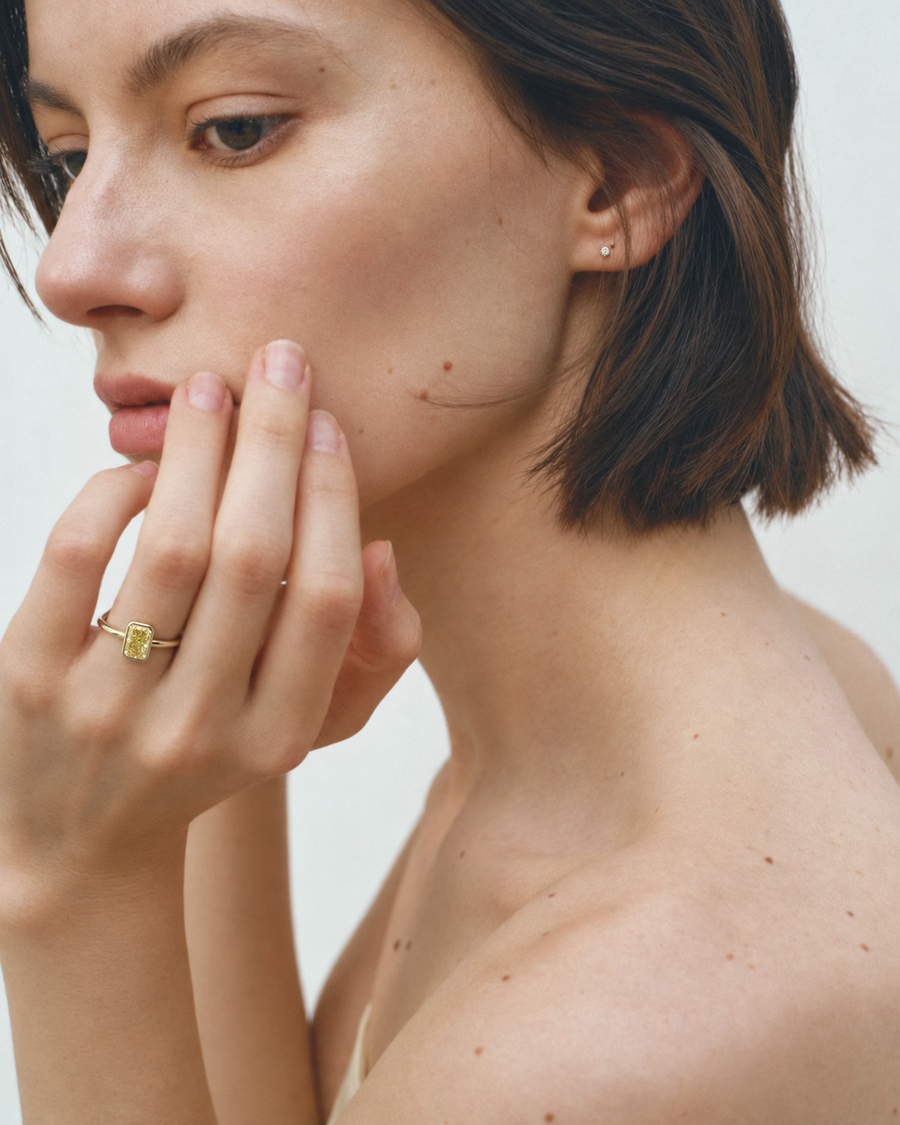
Orbit Yellow Bezel Ring — 18K Yellow Gold Lab-Grown Diamond Ring - 0.473 ct Total

Lien Lumière Necklace — 14K Gold Lab-Grown Diamond Necklace - 0.482 ct Total

18K Yellow Gold Lab Grown Diamond Ring - 0.686 ct Total

Lumière Oval Pendant — 14K White Gold Oval Modified Brilliant Lab-Grown Diamond Necklace - 1.52 ct Total


One note at a time.
New writing, new stones. Nothing else. Unsubscribe whenever you like.