
September 30, 2026
Lab-Grown vs Natural Diamonds, Moissanite & Cubic Zirconia
Four familiar stone names, four clear explanations. Compare composition, origin, hardness and appearance, then learn what to check in a gemological report.

The stone guide
Know your stone.
Natural diamonds and lab-grown diamonds are both diamond. Moissanite and cubic zirconia (CZ) are different materials. To understand a piece of jewelry, start with its full material name.
A lab-grown diamond has diamond’s carbon crystal structure and essentially the same chemical, physical and optical properties as a natural diamond. Its origin is different: it grows in a controlled environment, rather than forming in the Earth. “Real diamond” and “natural origin” answer different questions.
| Stone | Material & origin | Mohs hardness |
|---|---|---|
| Natural diamond | Crystalline carbonFormed in the Earth | 10 |
| Lab-grown diamond | Crystalline carbonGrown by HPHT or CVD | 10 |
| Moissanite | Silicon carbide (SiC)Jewelry stones are usually lab-grown | 9.25 |
| Cubic zirconia (CZ) | Zirconium dioxide (ZrO₂)Manufactured for jewelry | About 8.5 |
Mohs hardness measures scratch resistance, not resistance to chipping. The scale is not linear; even a diamond needs care.


These are material examples, not MERVAUX products or a controlled sparkle comparison. Lighting, cut and photography affect appearance; a photograph cannot establish a stone’s identity.
What does the price reflect?
Natural diamonds carry a different scarcity and market history. Lab-grown diamonds offer the diamond material at generally lower prices. Moissanite and CZ are priced as their own materials. A finished piece also includes its metal, design, setting and craftsmanship.
Purchase price, an insurance valuation and a resale offer are different figures. No stone’s name guarantees that you will recover what you paid.
Questions, answered.
Does “lab-created” mean cubic zirconia?
The full name matters. “Lab-created diamond” and “lab-grown diamond” describe diamond produced in a laboratory. CZ is cubic zirconia, not lab-grown diamond. “Lab-created” alone only describes an origin; ask which material follows it.
How is a lab-grown diamond actually grown?
A diamond seed provides a crystal surface; added carbon becomes more diamond. HPHT uses high pressure and high temperature. CVD uses carbon-containing gas in a low-pressure chamber. Both produce diamond. It is crystal growth, not a diamond coating over CZ.
How does it differ from a natural diamond?
The origin and growth history differ. Both have the diamond crystal structure and essentially the same chemical, physical and optical properties. Specialized gemological testing can distinguish them; appearance alone cannot reliably establish origin.
Are “synthetic” and “simulated” the same?
In gemology, a synthetic diamond is laboratory-grown diamond. A simulant resembles another gem while being a different material. Moissanite and CZ can be used as diamond simulants; neither becomes diamond because it looks similar.
Is moissanite a type of diamond? Is CZ natural zircon?
Moissanite is silicon carbide. CZ is zirconium dioxide. Neither is diamond. Natural zircon is a separate gemstone, zirconium silicate, and is not cubic zirconia. “Gemstone” is the broader category; it does not mean every stone is diamond.
Does more rainbow sparkle mean a better diamond?
Moissanite disperses more colored light than diamond. That is a material characteristic, not a diamond quality grade. Cut, lighting and personal taste also shape the appearance you prefer.
Will a lab-grown diamond become cloudy or wear out?
It does not turn into CZ or become cloudy simply because it was grown in a laboratory. Surface residue can dull its appearance. Both natural and lab-grown diamonds can chip; CZ is more susceptible to surface scratches and abrasion.
Is “organic versus non-organic” the distinction?
No. Carbon does not automatically mean organic. Natural diamond, lab-grown diamond, moissanite and CZ are inorganic crystalline materials. The useful distinctions are their composition, crystal structure and origin.
What should I check before buying?
Ask for the full material name, natural or laboratory-grown origin, any disclosed treatments, dimensions and carat weight. Different materials have different densities, so equal carat weights need not look the same size. Read any supplied independent report and verify its number with the issuing laboratory.
A basic thermal diamond tester may also respond to moissanite, and does not prove natural origin. At MERVAUX, check each product’s stated materials and the report details supplied for that particular piece.
Do all diamond laboratories use the same report format?
No. IGI laboratory-grown diamond reports include origin, measurements and 4Cs assessments. Since October 2025, GIA’s D-to-Z laboratory-grown diamond quality assessment uses the overall categories Premium and Standard. Read the actual report for your stone and check its issue date, terminology and report number with the issuing laboratory.
A gemological quality report records characteristics; it is not the same as a monetary appraisal. A document should be read for its stated purpose.
Further reading
Sample photographs: James St. John, moissanite and cubic zirconia, via Wikimedia Commons, CC BY 2.0. Images resized and cropped for display.
In the collection
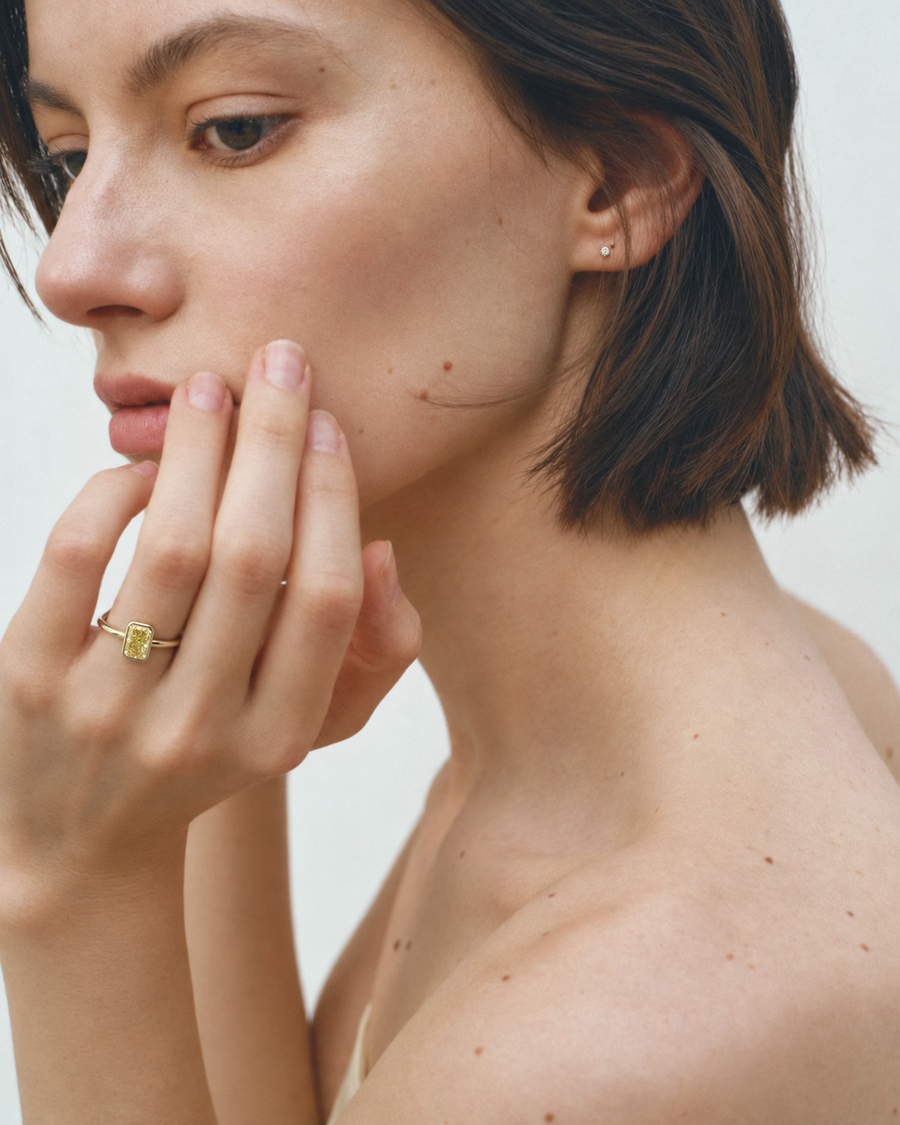
Orbit Yellow Bezel Ring — 18K Yellow Gold Lab-Grown Diamond Ring - 0.473 ct Total

Lien Lumière Necklace — 14K Gold Lab-Grown Diamond Necklace - 0.482 ct Total

18K Yellow Gold Lab Grown Diamond Ring - 0.686 ct Total

Lumière Oval Pendant — 14K White Gold Oval Modified Brilliant Lab-Grown Diamond Necklace - 1.52 ct Total


One note at a time.
New writing, new stones. Nothing else. Unsubscribe whenever you like.